
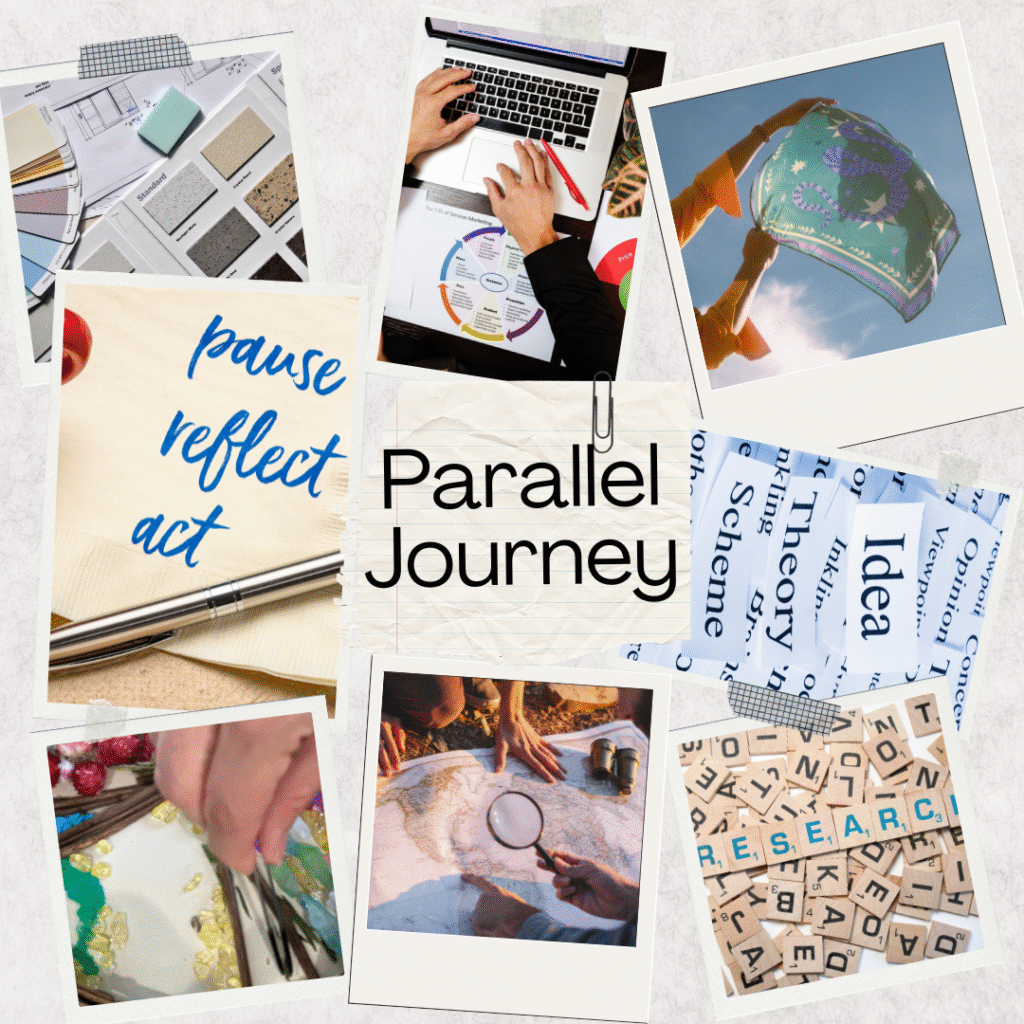
When we think about children’s learning, it’s tempting to imagine yourselves as the guide holding the map. But within the Revisiting Journeys Framework, you are not the experts with all the answers. Instead, you walk beside children, asking questions with them, discovering alongside them, and learning in parallel.
These parallel journeys are not distractions from your work; they are essential to it. When children are curious about a topic, you embark on your own lines of inquiry—researching, experimenting, reflecting, and revisiting. This dual journey enriches your practice, deepens your understanding, and opens new pathways of possibility for children and educators alike. More importantly, your creativity is sparked, keeping you engaged and open to new learning.
Why Parallel Journeys Matter
Discerning when children are entering a revisiting journey requires courage, felxibiity, understanding, and a willingness to embrace the unknown. Sometimes you believe children are investigating one thing—like the role of firefighters—only to realize they are exploring something entirely different, such as their power to control their environment.
Instead of interpreting these shifts as mistakes, you can view them as invitations. They remind you that you are not passive observers but active collaborators in children’s evolving inquiries. Parallel journeys create opportunities for educators to reflect, question assumptions, and continually reimagine how we support children’s play and learning.
The Actions of a Parallel Journey
So what does it look like for educators to live a parallel journey? It often includes four interconnected practices:
- Action Research – You investigate the same theories that children are exploring. If children are curious about pigmentation, we dive into color theory, connect with local artists, and curate resources to expand their inquiry. Research sparks our curiosity and allows us to model lifelong learning.
- Adult Play – You experiment with the same unscripted materials you offer children. By rolling clay, testing paper folds, or exploring digital projections yourselves, you uncover the materials’ affordances. In play, you learn to see through the eyes of children and gain confidence in curating meaningful play ecosystems.
- Community Partnerships – You seek out knowledge beyond yourself. Families, local artists, museums, and community centers all become collaborators in expanding children’s learning worlds.
- Chronicling – Children become the guides in the documentation process. You not only document what children do but also what you, as an educator, discover along the way. This ongoing cycle of collecting, reflecting, and revisiting keeps the process visible to ourselves, children, and families.
Together, these actions transform your roles. You shift from being holders of knowledge to being co-researchers, learners, and adventurers.
What Parallel Journeys Teach You
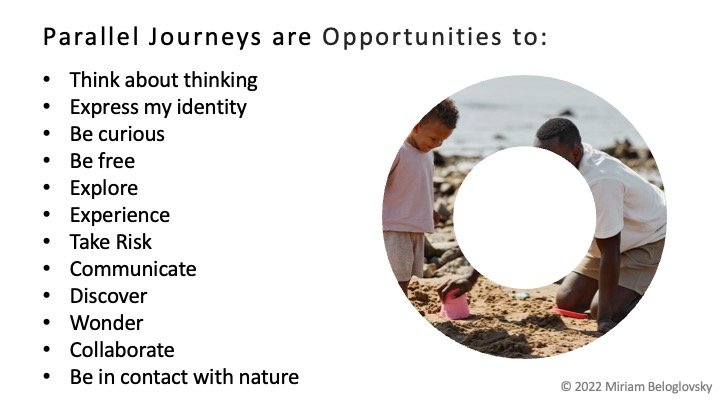
Parallel journeys remind you to:
- Recognize what you don’t know—and lean into the joy of discovery.
- Redefine your role as learners, not experts.
- Build curiosity-driven efficacy that sparks continued questioning.
- Create cultures of inquiry that bridge opportunity gaps and foster equity in play ecosystems.
By modeling inquiry and reflection, you demonstrate to children that learning is not about arriving at the “right answer” but about cultivating wonder, persistence, and joy.
Parallel Journeys in Practice
A sotry shared by a director of an early learning program, demonstrates how embracing parallel journeys helped her grow in her practices.
“I noticed that some educators were hesitant to use unscripted materials. Instead of traditional meetings filled with policy reminders, we held reflective sessions where educators engaged with the same materials they planned to offer children. They shared observations, experimented through play, and reflected on their experiences together. Slowly, their confidence grew. They no longer feared failure but saw it as part of the process of revisiting. These experiences helped them embrace their own journeys of curiosity.”
The reflection above illustrates the essence of parallel journeys: when educators immerse themselves in inquiry, they create ripple effects that strengthen confidence, creativity, and collaboration across the entire learning ecosystem.
Embracing the Journey
Parallel journeys are not linear. They are winding, surprising, and filled with moments of self-doubt. Yet, when you embrace them, you rediscover that the heart of teaching is learning with children.
By revisiting, reflecting, and reimagining alongside children, you grow into educators who isnot only facilitators of knowledge but also seeker of wisdom. In doing so, you create play ecosystems where curiosity thrives, questions multiply, and both adults and children embark on lifelong learning journeys.
A parallel journey is not a solitary path, but one that encourages educators to focus on their curiosity and inquiry about children’s interests. It’s a journey that thrives on questioning, reflection, and reimagining learning. It’s a journey that necessitates collaboration, research, and shared learning. This collaborative aspect makes visible the intentional planning that guides them. When we are diving into unfamiliar territory, our thinking may feel messy at first. We may be unsure of where to start or how to proceed. This discomfort is a natural part of the learning process.
Final Thought: Parallel journeys remind us that education is not about leading children to our answers, but about walking with them toward shared discoveries.